FRAMING REVIEW
Systematic verification of geometric alignment, crop boundaries, art direction overlays, and margin buffers on every incoming capture.
TECHNICAL SPECIFICATIONS
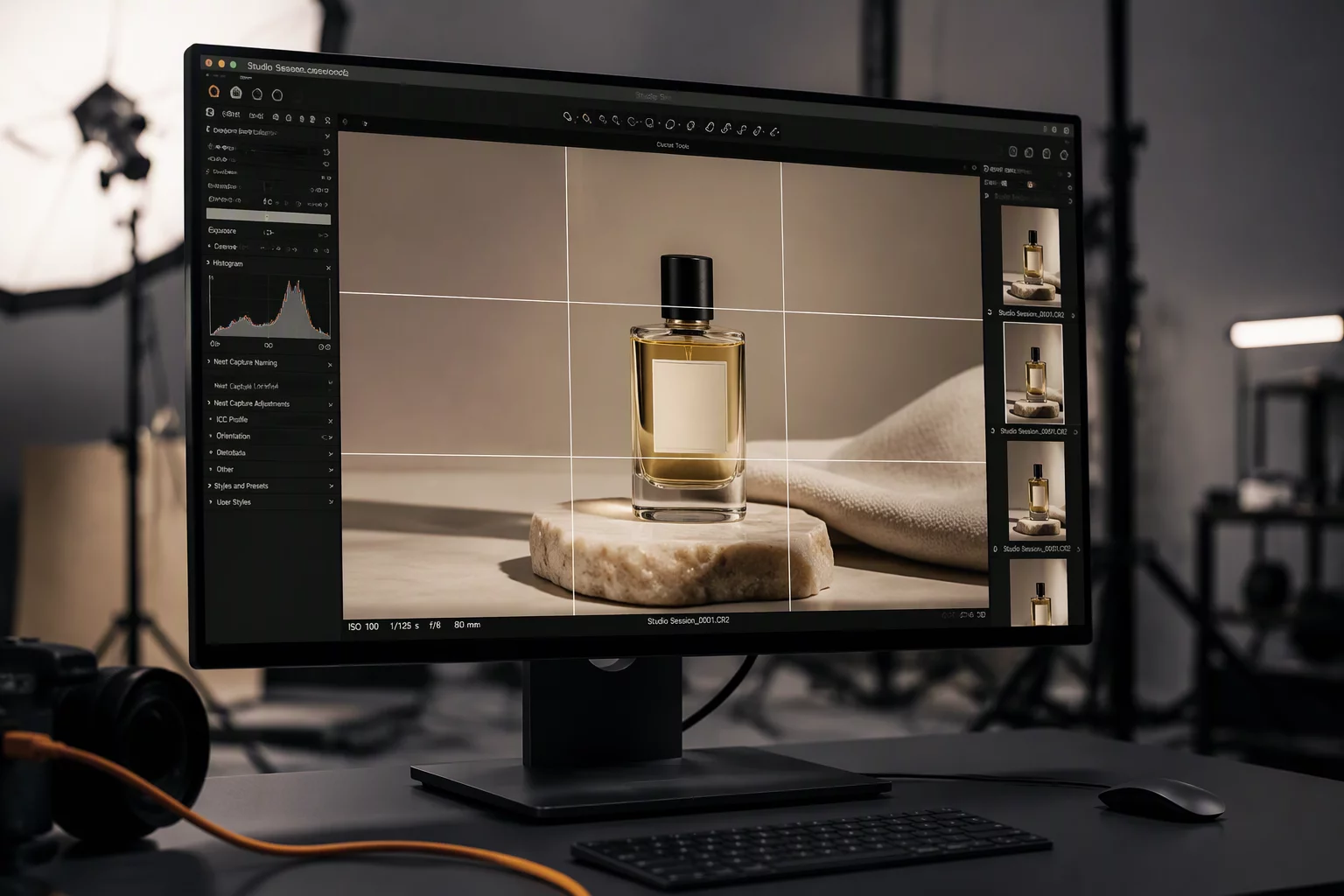
Each incoming exposure undergoes live verification against layout overlays, lens distortion tolerances, and delivery aspect ratios directly in the tethered review environment.
| Parameter Checkpoint | Standard Value & Criterion |
|---|---|
| Digital Guide Alignment | Active rule-of-thirds and optical center crosshairs calibrated to baseline art director brief |
| Crop Ratio & Safe Zone Mask | Pre-configured 4:5 social bleed, 1:1 e-commerce square, and 16:9 responsive banners checked simultaneously |
| Geometric Horizon & Keystone | Dual-axis leveling tolerance under 0.3° deviation using edge line-detection or calibrated spirit overlays |
| Edge Clearance & Headroom Buffer | Minimum 12% border margin preserved on full sensor RAW for dynamic typography and digital packaging crops |
| Ghost Overlay Comparison | 50% opacity onion skin referencing approved hero shot to guarantee zero framing drift across variations |
| Focal Length Perspective Distortion | Subject plane perpendicularity verified against wide-angle barrel curvature and edge elongation |
FRAMING EXECUTION WORKFLOW
Framing consistency separates haphazard studio captures from clean, post-ready assets. When tethered shooting begins, camera placement frequently encounters subtle micro-shifts caused by heavy zoom barrels, floor vibrations, or accidental tripod bumps. Digital technicians maintain a rigid framing checkpoint at the monitor station before calling a set approved, scrutinizing whether hero packaging lines, model posture, and negative space match the layout grid.
By enforcing live crop masks directly inside Capture One or client monitor sessions, the tether desk eliminates guesswork for art directors and external stakeholders. Instead of hoping an image will crop cleanly into an Instagram vertical, web billboard, and print packshot later, technicians evaluate every critical boundary while the lighting and talent remain in place.
- Lock tripod pan handles and ball heads with verified torque once initial grid alignment matches the mockup overlay.
- Toggle overlay guides across multiple aspect ratios before clearing talent or resetting the set styling.
- Audit corner perimeters on incoming RAW captures for unexpected boom arms, C-stand knuckles, or light spill.
Consistent framing discipline reduces turnaround time in post-production by cutting down manual repositioning, canvas extensions, and perspective warping. When every capture lands squarely on registration marks, retouchers focus entirely on color fidelity and polish.
FRAMING FAQ
ADJACENT PROTOCOLS
Framing review works hand in hand with precision focus checks, lighting continuity logs, and styling consistency.