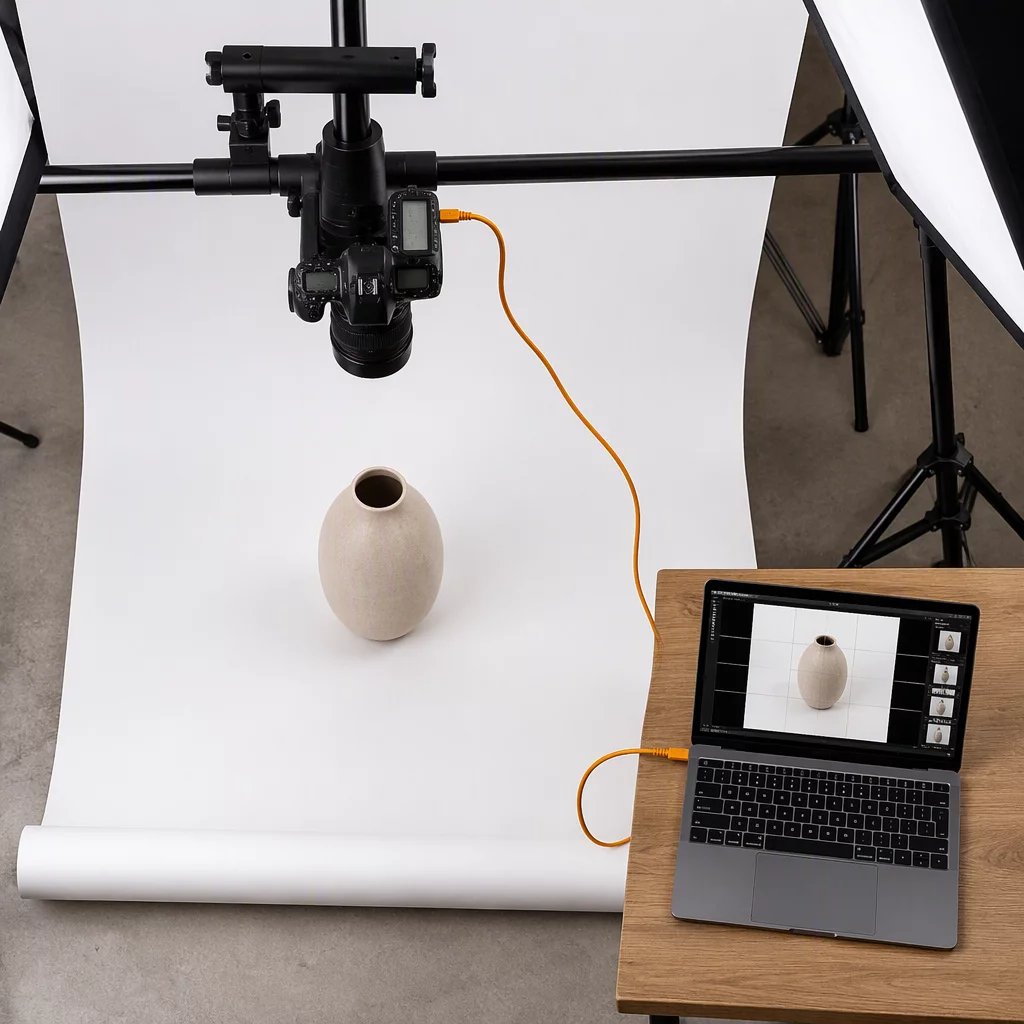
Sharpness Passed, Geometry Failed
On a commercial still-life set last quarter, the incoming frame looked flawless. The embossed logo held perfect edge acuity at 100% crop, the exposure histogram sat exactly on the reference curve, and the digital tech called the capture clear. Thirty seconds later the overlay comparison told a different story: the bottle had rotated nearly three degrees and shifted four millimeters off the registered mark. The art director rejected the frame because the label no longer faced the key light at the agreed angle.
Focus is a property of the lens-to-product relationship. Position is a property of the set itself. Verifying the first while assuming the second is the most common false pass in tethered review, and it is responsible for more packaging reshoots than any soft-focus error.
Where Movement Actually Comes From
Products rarely move in dramatic ways. They creep. Bearings release stored tension after the turntable motor stops, set tables flex when an assistant leans in to adjust a flag, and a well-meaning stylist nudges the hero item while smoothing a background seam. None of these changes register on the focus readout.
“The camera did its job perfectly. The frame was critically sharp — on a product that had rotated three degrees out of register.”
- Turntable bearing play releasing tension after the motor stops.
- Set tables flexing when crew lean across to adjust flags and cards.
- Products re-seated by hand between takes without a mechanical stop.
- Cable drag on the camera rig shifting the frame axis mid-sequence.
Locking Position Before Approving the Frame
The fix is procedural, not optical. Pin a reference overlay at the first approved capture and compare every subsequent frame against those datum lines rather than against memory. A drift tolerance of ±1 mm or ±0.5 degrees triggers a hold: the product is re-seated, the overlay is re-verified, and only then does the sequence resume.
The order of operations matters. Correct the physical position first and re-check it before any lighting parameter is touched. Adjusting light to chase a rotated product produces two unknowns at once and breaks the single-variable rule that keeps tethered sets fast and accountable.